As our eldest child prepares to graduate from high school, I’ve been reflecting on our homeschooling journey through the years. It dawned on me that as of this year, I will have homeschooled every grade from K-12, and we will have been homeschooling at least one child for nine years straight. Time has flown by too fast.
We hadn’t planned to homeschool our kids, as I wrote about here, and certainly never planned to homeschool during the high school years. But as the years went by and life took us in new directions, it became more and more evident that this was what we were called to do.
Now looking back over our nine years of homeschooling, I realize this journey has been just as formative for me as it has been for the kids. I’ve learned so much being their teacher and guide – not just about math, science, literature, history, but about what it is to be human, to be truly and fully alive and engaged with the world around us.
Here are nine lessons I’ve learned about homeschooling through the years:
Year One (Spring 2018): Homeschool Is Not School at Home
- Number of Homeschooled Kids: 1
- Grade(s): 4
I remember my daughter’s first day of homeschooling so vividly. We had just withdrawn her from her public charter school halfway through the school year, after I decided to take a break from working full time to focus on our growing family. She’d been asking if we could homeschool her for a long time, and now that I had more time on my hands, we finally agreed to give it a shot.
I had our first day meticulously planned out. It was a jam-packed school day, with blocks scheduled from 8AM to 3PM – because that’s how long a normal school day is, right? Imagine my surprise when, by 11AM, we had completely finished all her lessons for the day, and she was off in the backyard playing with her little brother.
That first day showed me there’s a big difference between brick and mortar school and homeschool, but it took me years to realize what a gift that is. For a long time I tried to do things the way they do in school, and more often than not, it didn’t work. The more I’ve stopped trying to make our homeschool look like a conventional classroom, the less anxious and stressed I’ve felt as the years have gone on.
Year Two (2018-2019): It’s Okay to Take Breaks
- Number of Homeschooled Kids: 2
- Grade(s): 5, 2
In summer of 2018, we left our home in San Antonio, Texas, and moved to Maryland, just outside Washington, DC. It was a big move for us, and not an easy one for our oldest daughter, especially. To top it all off, I was about halfway through my fifth pregnancy. We decided that to help with the transition, we would homeschool all the kids for the fall semester instead of sending them to school. (Needless to say, it ended up being for much more than one semester!)
Shortly after our move, I went to a social gathering for local homeschooling moms. At the event, a veteran homeschooler gave some advice I hadn’t heard before. She said sometimes it’s okay to take breaks, even just to get the house in order and regain a sense of calm. At the time, this advice was shocking to me. I had never considered the possibility that homeschooling in a state of chaos and overwhelm is actually counterproductive.
This advice has been especially helpful during times of transition, such as after the birth of a baby or a big move. It’s helped me stay grounded in times of sickness. I like to think of it as similar to fitness and exercise. Without rest days, all the work you’re doing will just break your body down and lead to burnout. It’s the same with homeschooling.
Year Three (2019-2020): It’s Okay To Make Your Own Curriculum
- Number of Homeschooled Kids: 3
- Grade(s): 6, 3, K
I’ve always been attracted to the idea of out-of-the-box curriculum, mostly due to the convenience. When I first started homeschooling, I thought if I could just find the right curriculum that met our kids’ needs and also aligned with our family vision, it would be smooth sailing from there. Just buy the books, check off the boxes, and you’re set.
Around this time in our homeschooling experience, I realized this isn’t the best approach for my personality. I know it works for some people, but I’m not one of them. I found myself feeling frustrated when I fell behind the pre-set plans.
So I stopped trying to find the perfect curriculum to use for all the kids and started researching different homeschooling styles, materials, and books. It’s still a work in progress, but I love being able to find materials that are best suited for each individual child and make my own plans for the year, as opposed to spending a ton of money on a blanket curriculum program that I’ll probably end up modifying.
Year Four (2020-2021): You Can Do School Anywhere…Even in a Hotel or in Bed
- Number of Homeschooled Kids: 3
- Grade(s): 7, 4, 1
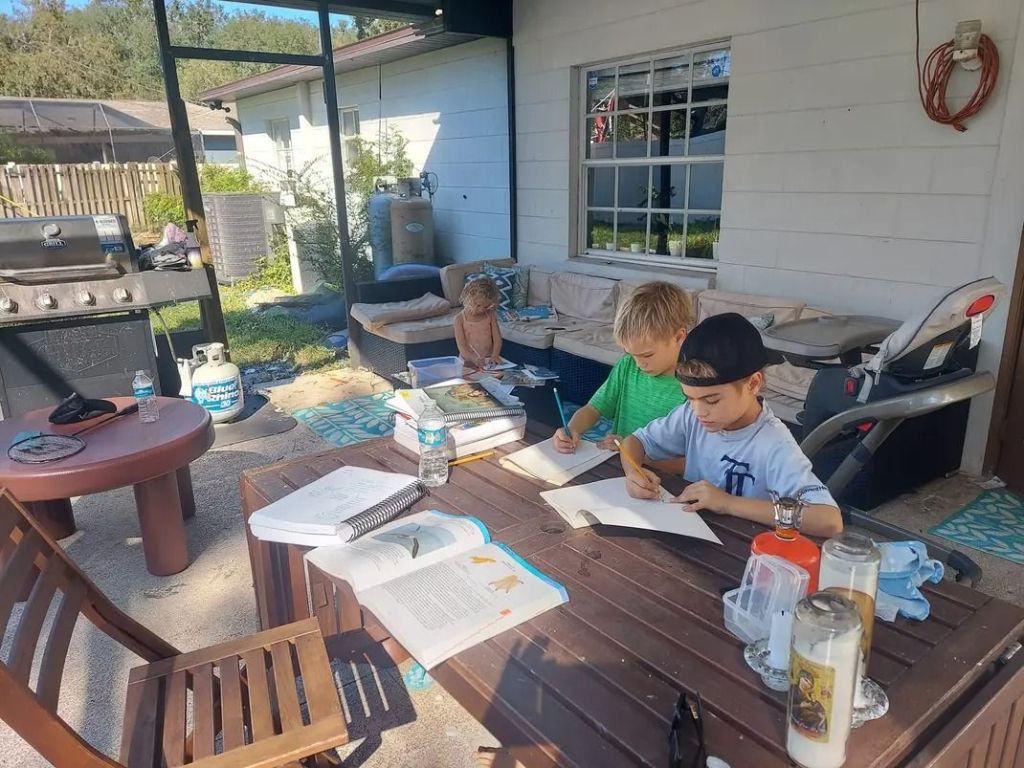
Ah, 2020. So many things to say about that crazy year. For our family, there were some great memories made, mostly because everything was canceled and we had a lot of time on our hands. We also spent a lot of time outside that year. In the early fall, we started a fun new activity called “Park School”. We would pack up our books and a bagged lunch and travel to local parks to do our schoolwork.
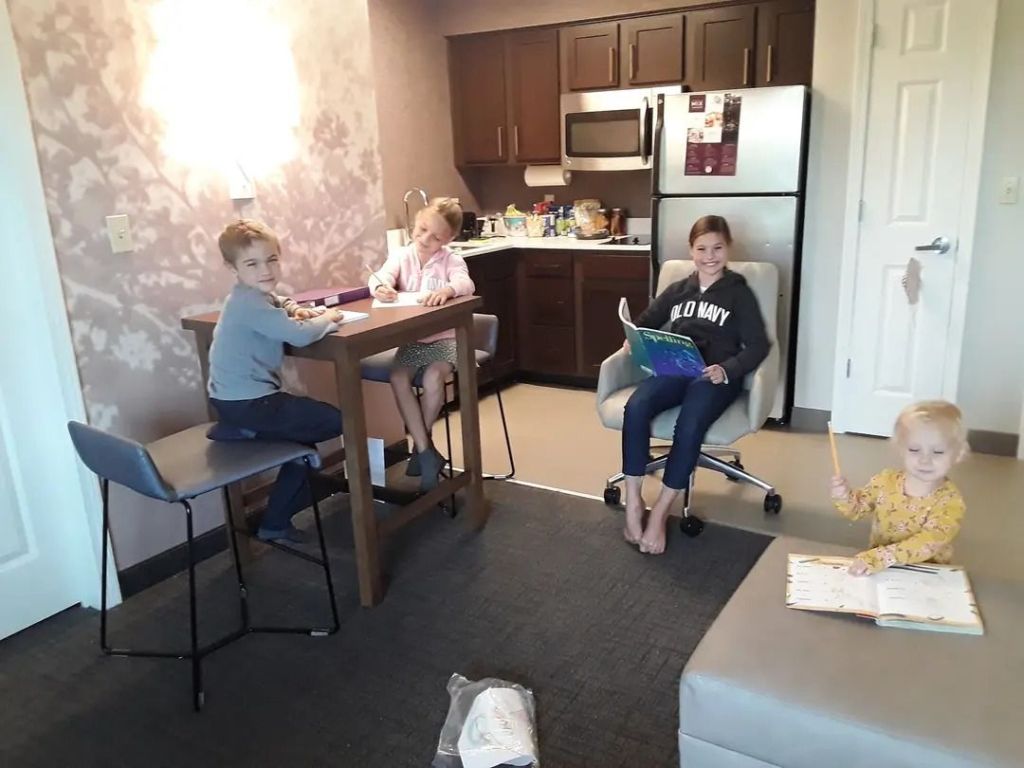
Then, in September 2020, a horrible flood struck our area. We had five feet of water in the basement, which forced us to move out of the house for a few weeks. We packed up all the school books, and for those weeks we did our school work from our Residence Inn hotel room. “Hotel School.”
Finally, in the spring of 2021, I gave birth to our sixth child. After years of being told by midwives that I should observe a two-week “lying in” period, I finally acquiesced, but since she was born at the end of April, I still wanted to resume our family studies as soon as possible. So every day, each child would take a turn coming downstairs to my bed, and we would have “Bed School”. I will always remember those slow, quiet days reading in bed and nursing baby Ursula.
This was the year I realized the amazing versatility of homeschooling. And funny enough, despite all the chaos and interruptions, I think this was one of our most successful school years.
Year Five (2021-2022): Combined Ages/Grades Are Your Best Friend
- Number of Homeschooled Kids: 4
- Grade(s): 8, 5, 2, K
During our first few years in Maryland, we were part of a Charlotte Mason homeschool group. One of the things I loved most about it was that the kids all came together in one, big, all-ages group. It was so beautiful to see the older kids leading and guiding the younger ones, and the little ones looking up to their older friends.
Year Five was a daunting year for me, with my largest cohort ever, up to that point: Four kids, including a kindergartener all the way up to an eighth grader! Fortunately, it was around this time that I learned about unit studies from companies like The Good and the Beautiful and Gather ‘Round. We did several subjects – history, science, and health – with all the grades combined, and a few others – Latin and poetry – in smaller groups.
This approach had (and continues to have) a few advantages:
- First, it was way less work for me. Instead of doing astronomy with my fifth grader, general science with my eighth grader, nature studies with my second grader, and science read-alouds with my kindergartener, we all did the same science unit study, with added activities to challenge the older ones.
- Second, the kids learned so much more by interacting and engaging the same subject matter. They played space trivia, read space books that were at their learning level, and talked about what they were learning.
Year Five taught me something I already knew intuitively: Learning together is always more potent than learning alone.
Year Six (2022-2023): What Works For One Child Might Not Work for Anyone Else
- Number of Homeschooled Kids: 3
- Grade(s): 6, 3, 1
Six years into homeschooling, I was getting a little complacent. Our oldest was in ninth grade and attending a local high school, since we hadn’t originally intended to homeschool for the high school years. I’d been doing this for a while now and had officially homeschooled all the grades K-8, so I figured it would be smooth sailing from here – I could simply replicate what I’d already done until our last kid went to high school. No problem!
I quickly realized this was a hasty assumption. My first grader was struggling with reading, and our sixth grader was having a hard time with Latin. The books I’d used for their older siblings weren’t working for them.
Not only that, but their interests were different from my plans. For example, I had a very specific track planned for K-8 science, which called for studying mammals in third grade. Unfortunately, my third grader wasn’t very interested in mammals, although he was fascinated with bugs. Should I stick to the plan and force him to learn about edentates? Or would it be acceptable to go with his interests and study insects this year?
In a nutshell, this year taught me that every year is new. Just because I’ve homeschooled every grade at this point doesn’t mean I can assume to know what each individual child needs, at each stage in his or her learning journey. Homeschooling isn’t about creating a template – it’s about listening to our children, getting to know them, and creating a learning plan that takes their unique personalities into account.
Year Seven (2023-2024): Your Family Is Your Best Friend Group
- Number of Homeschooled Kids: 4
- Grade(s): 10, 7, 4, 2
Year Seven was another big year for our family. This was the year we moved to Florida – not to follow a job or any other obligation, but simply because we wanted to live in Florida. We wanted to be close to the water, to spend our time fishing, swimming, maybe even sailing. We wanted to live in a place where we could be outside most days of the year. We wanted to get away from the political chaos of the DC area. We wanted to go back to the place where my husband and I first met and fell in love.
And so we decided to give it a try. We followed our intuition. But it wasn’t easy. We worried that we were uprooting our kids from family and friends in Maryland. Were we being selfish by taking them away from these relationships? On a practical level, would we be able to keep up with homeschooling the kids during this transition?
We lived in a small AirBnb for the first three months here in Tampa while we tried to discern whether or not we should stay in Florida. Once again, we decided to homeschool all the kids (even our 10th grader), even though we had said we’d never homeschool during high school. We started over from scratch and joined a local homeschool co-op to make new friends. We missed our friends and family, deeply.
But something else happened during that time: We rediscovered our family identity. We talked to each other, a lot – including some tough conversations. We went on adventures. We got to know each other better than we ever had before. We grew up.
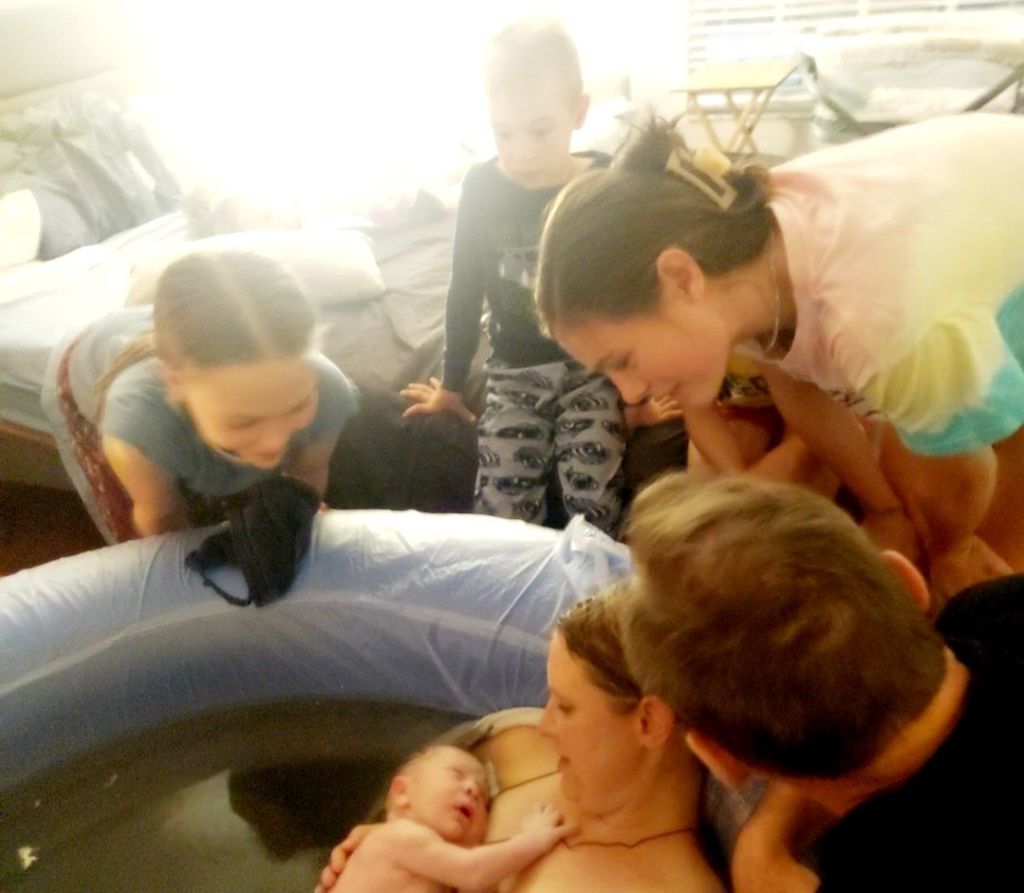
Year Seven taught us that these people we’ve been given, day in and day out, to live all the ups and downs of life with, are truly our best friends. And at the end of that year, on Holy Saturday, we welcomed our newest family member, born at home and surrounded by his siblings.
Year Eight (2024-2025): Adventure Is the Best Teacher
- Number of Homeschooled Kids: 5
- Grade(s): 11, 8, 5, 3, K
Our second year in our new home was full of adventure. We traveled to the Atlantic side of Florida for surfing lessons. We navigated a few hurricanes, one of which culminated in an evacuation and the loss of our beloved avocado tree (thankfully, nothing else). We took a two-week road trip to Virginia. We snorkeled in the Gulf, kayaked in the Hillsborough River, and competed our first triathlon, followed by a few more. In spring 2025, our oldest daughter (age 16 at the time) headed to Colombia for a two-month study abroad adventure.
I love learning the etymology of words. The word “adventure” has a lot of meanings, but the one I love most is the simple one: “A thing about to happen”. An adventure is something you anticipate, look forward to, train for. This sense of anticipation is what makes an adventure permeate all aspects of life. And yet, while it’s important to be prepared, ultimately you have to let go of your expectations in order to let an adventure take place.
To seek adventure is dangerous. You have to be willing to accept the possibility that things might not go as planned, while also holding onto the hope that your work and planning will come to fruition. What better lesson to teach our kids while they’re still young?

Year Nine (2025-2026): It’s Okay to Learn As You Go
- Number of Homeschooled Kids: 5
- Grade(s): 12, 9, 6, 4, 1
Nearing the end of Year Nine and approaching our first high school graduation, I’m reminded of an experience I had almost eight years ago now. My husband and I were in the hospital, about eight hours after the birth of our fifth child. The nurse came in to check on me in the wee hours of the morning. After seeing in my records that this was our fifth baby, she waved her hand dismissively and said, “Well, you’ve had a lot of kids already! You already know everything you need to know.”
In that moment, my immediate reaction was to say, “No! I don’t know it all. This is all so new to me.” Even though I’d done this four times before, the experience was somehow entirely new. I was still learning, even though I’d done this before on paper. I needed help, and that was okay.
Rounding the corner of Year Nine, I still need help. I am learning right alongside my children. I don’t have the answers, but I have a whole lot of questions, and I’ve come to see that perhaps this is what our children need most: To see us grown-ups asking deep and meaningful questions. To witness our own quest for truth and clarity.
So don’t be afraid to let your children watch you learn. Don’t be afraid to mess up. Don’t be afraid to say, “I’m not sure. Why don’t we look into it together?” Ask them to learn alongside you.
Looking back at these nine years, I can say learning together has played a key role in fostering trust and creating a bond with my kids, which is far more important than grades, career readiness, or any other metric we use to gauge homeschooling success.

Leave a comment