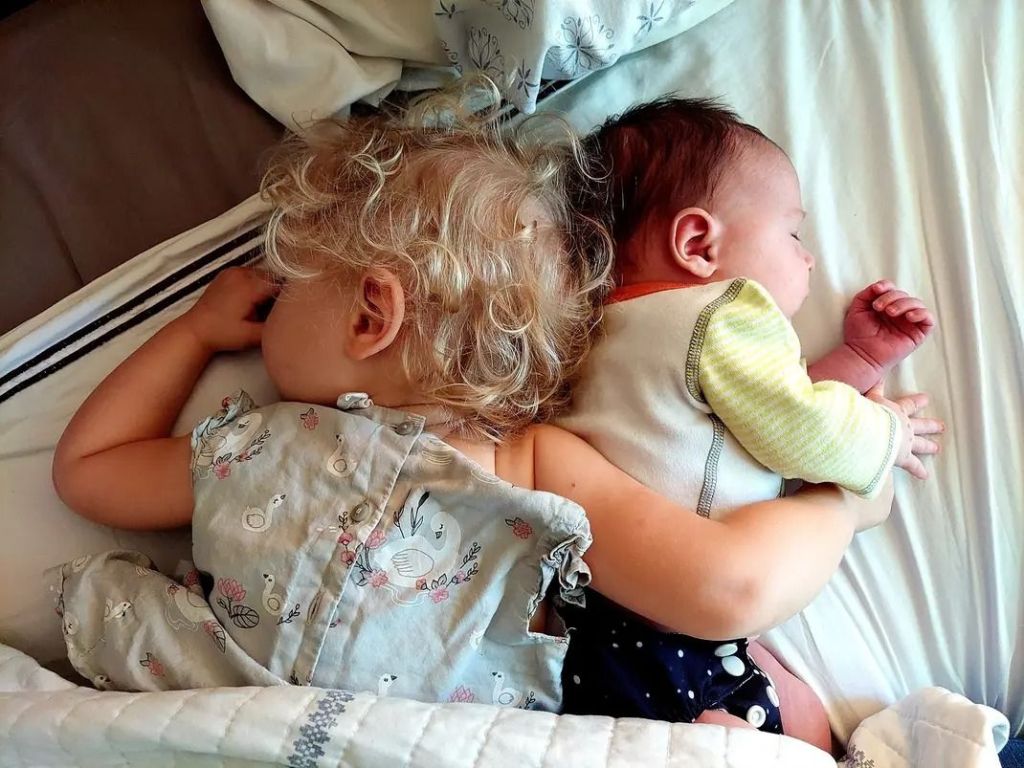
Last year we threw a party for our daughter’s 7th birthday. When I asked her who she wanted to invite, the people at the top of her list were her 17-year-old, 14-year-old, and 4-year-old sisters’ friends, right along with her own.
At first I laughed and said she had to limit her invitations to girls her own age (or at least younger than 9!), but after a bit of thought I reconsidered. What a beautiful thing, especially for such a momentous age as seven, to have a whole village of girls at her party.
So we invited them all. Surely only the younger ones would come, right?
To my amazement, all of them showed up. We had 20 girls total, ranging from age 4 to 19. It might sound sentimental, but watching a bunch of teenagers play Duck Duck Goose with girls 10+ years younger with them truly moved me.
I found myself wishing I could bottle this dynamic up and keep it safe in a little jar for my daughters to carry along with them as they grow up and venture out into “the real world”: a place where girls are so often misunderstood, neglected, or, as recent news stories so clearly illustrate, mistreated and abused.
If only…
Just a Girl
I know I’m not the only one out there who grew up with a sense of confusion about what it means to be a girl. The mixed messages were overwhelming. On the one hand you had the “Mean Girls” image of girls as catty, two-faced, and downright obnoxious. There was the “Clueless” image of girls as shallow and vapid. There were the old-fashioned, prim and proper girls who were unjustly prevented from doing the things boys did. There was the classic 90’s tomboy who defied all the rules of girliness and played sports against everyone’s wishes (especially the boys’).
And underlying all these stereotypes was an identity vacuum, best summed up by the classic 90’s Girl Anthem:
“I’m just a girl…
I’m just a girl in the world
That’s all that you’ll let me be
Oh, I’m just a girl, living in captivity
Your rule of thumb makes me worrisome
Oh, I’m just a girl, what’s my destiny?
What I’ve succumbed to is making me numb
Oh, I’m just a girl, my apologies
What I’ve become is so burdensome
Oh, I’m just a girl, lucky me
Twiddle-dum, there’s no comparison
Oh, I’ve had it up to here…”
Nowadays the question of what it means to be a girl seems antiquated and irrelevant. Perhaps that’s partly because both girlness and boyness have slipped into a strange kind of androgyny. We’ve spent so much time focusing on the superficial signs of boyness and girlness – pink or blue? Barbie or GI Joe? – that we’ve just given up, and for good reason. When you reduce what it means to be a girl to nail polish, pink bows, and Barbies, it makes sense that girls would throw up their hands in frustration and deny their girlness.
The problem is, when we stop trying to answer that question, we start to feel a lot like Stefani describes in our 90’s Girl Anthem: worried, numb, burdensome, angry. And then comes the worst feeling of all for a being created to exist in communion with others: the feeling of being absolutely alone.
Lest I seem overly dramatic, here’s some evidence that supports the idea that women and girls feel increasingly alone in contemporary society:
- “Young, Educated Women Are Both Highly Connected – And Very Lonely”
- “Teenage Girls Are the Loneliest Group in the World”
- “Nearly 70 percent of girls ages five to 13 experience loneliness”
- Girls at higher risk for body image issues related to social media use
One of the studies defines loneliness as the “‘…painful feeling’ that arises when people do not have the kind of relationships they want.” Even with all our networking, social media, and 24/7 virtual communication, women and girls feel cut off – from each other, from their bodies, from themselves.
Tend and Befriend
Another interesting study from 2024 explored the female stress response. It contrasted the common “fight or flight” paradigm with one that is more common in women (though also present in male stress response): “Tend and befriend.”

The researchers suggested that in addition to the classic “fight or flight” reactions, women tend to manage stress by “tending” (caring for their children), or “befriending” (associating with other people, particularly other women).
The Pew Review on loneliness in America supports this solution and even included the following tidbit:
“Two-thirds of Americans say all-female social groups have a positive impact on women’s well-being. This is higher than the share saying all-male groups have a positive impact on men’s well-being (56%). Americans are also more likely to say women-only groups have a positive impact on society than to say the same about all-male groups (57% vs. 43%).”
Perhaps not surprisingly, one solution to the rise of loneliness, stress, depression, and anxiety in girls today could be pretty simple: Find ways for them to engage in real-life interactions with other girls.
Girls are often given the message that they need to be strong, independent, self-sufficient. There’s nothing wrong with these qualities. But without a fundamental openness to others and to life with all its twists and turns, strength and independence are meaningless.
True independence, strength, and self-sufficiency only grow from the soil of interconnectedness. Ultimately, they must stem from love. And love requires community.
I want my daughters to be able to navigate the world with confidence and bravery. I want them to trust their intuition. But none of those outcomes are possible without a family, a community, a tribe. When we teach girls to pursue ambition at all costs, to ignore their intuition, and to isolate, we’re opening the door to so many of the problems girls face in our culture today.
The birthday party was a little glimpse of how I want my daughter to experience this community throughout her life. I hope as she grows up and moves outside our little bubble, she always knows she’s not just a girl – she is a daughter, a sister, a niece, granddaughter, friend.
She is a necessary and integral part of a family of women who love her and want the best for her. The world is not the same without her.
She enriches the world, just with her presence.
I pray she will always remember she is capable of both great strength and deep, profound love – and that those two can, and must, always co-exist.

Leave a comment