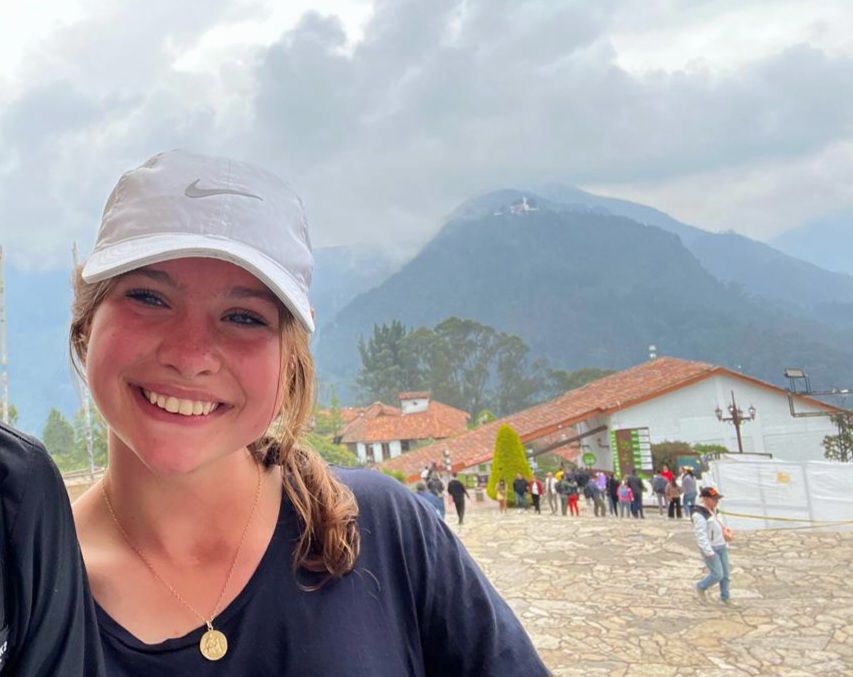
A little over a year ago, my husband took a work trip to South America to visit a school. He fell in love with the people, the beauty, and the culture of the place. On his return home he was convinced that our kids should visit as part of our homeschool high-school curriculum. He and the school rector wasted no time in hatching a plan for our daughter (now a junior in high school) to come visit the school in 2025.
My immediate reaction was that the trip sounded amazing. I’ve always believed travel is one of the best ways to teach kids about the world, and one of the primary reasons we homeschool is to allow for frequent and spontaneous adventures. The school and community sounded warm and loving, and the place looked breathtakingly beautiful. As an added advantage, our daughter might even be able to pick up some Spanish on the trip. Of course she should do this – what an incredible opportunity!
But as time went on and the trip became more and more real, I started to worry. What if she hated it? What if the kids were mean? What if she didn’t like the food? What if she got sick? I found myself waking up at night panicking at the thought of her being so far away for two whole months, in a place I had never been, with people I had never met.
Before I knew it, we were three weeks out. The plane tickets were purchased, the host families were selected, the plans were made. It was happening, but my worries were not going away.
I discussed these fears with my husband, and he was very understanding. He also suggested I talk to my daughter about my concerns. Not because it would stop the trip – she was dead set on going and didn’t share any of my fears – but simply to let her know what was on my heart.
Maybe it sounds crazy, but I hadn’t thought of that, and the more I did, the more it struck me as a good idea. In fact, it seemed like exactly what was needed to put my mind at rest.
So I waited for the topic of her trip to come up naturally (which wasn’t hard because it was all she talked about!), and then I gently told her how I’d been feeling. I didn’t try to scare her because my goal was not to make her change her mind. I just told her that as excited as I was for her, I was also scared of being so far away from her for so long. I told her it was important to me that she take good care of herself and communicate right away if she had any concerns. And I reiterated that she had better call me every day.
She listened generously. She didn’t roll her eyes or complain about my worrying. She didn’t even argue with me about any of my concerns (and she does enjoy arguing, so that’s saying a lot). She simply listened, and then, after I’d expressed my fears, she gave me a big hug and thanked me for telling her. She said she didn’t blame me or think less of me for being afraid.
And then she said I could trust her, and that she felt in her heart that this was something she was supposed to do, and that she was so grateful and excited to go on this adventure.
I knew after that conversation that she was ready. I trusted that this trip was the right step to take, because I trusted her. That was the last time I woke up at night with worries and fears.
Stay Dangerous
A few weeks after I met my husband, about 20 years ago, we were sitting outside talking as we liked to do. I was explaining why I didn’t want to get married or even date any time soon – namely, because people (and especially men) aren’t trustworthy and ultimately only cause pain. Love can only lead to heartache. Even if the person you love proves to be everything you thought they were, there’s the reality of death to deal with at the end of it all. (I was quite morose on this particular night.)
“So you’re going to spend your whole life living in a little shell and never loving anyone just because you don’t want to get hurt?” he said. “Wouldn’t you rather fall madly in love with someone, even if it means you might get hurt?”
That was a nice pick-up line. Six months later, we were engaged.
And now, 20 years later, we have this little blog called “Stay Dangerous.” This title is not meant to suggest that all danger is, in and of itself, good. But there is a certain kind of danger that is worth having in your life, and that’s the danger of trusting the goodness of the world, the goodness of people, the goodness of love.
The world is a good place and full of wonder. People are good and worthy of our love and attention. Our children are good and worthy of our trust. We can give ourselves permission to love without reservation.
Trust is dangerous because it requires you to dwell with the possibility that you could be totally wrong about everything at any given moment. What’s more, from a young age we are led to believe people are at bottom untrustworthy, two-faced, and ready to deceive. Deciding to trust someone is risky business. Especially teenagers.
The only way to never be wrong is to not allow yourself to be vulnerable. But at some point in life we all have to make a decision: Am I willing to take a risk and be wrong? Am I willing to take a risk and get hurt?
Perhaps the better question is: Am I willing to take a risk and experience meaning, truth, and freedom? Am I willing to love?

Fear Has a Message
Fear is complicated. Sometimes, there’s reality written in our fear, and we need to listen to it. Other times, fear is an obstacle to truth and freedom.
As a parent, how do you discern whether or not your fears are valid? How do you know when to listen to fear and take a step back, as opposed to pushing through it?
I wish I knew the answer all the time, but in this specific instance of our daughter’s trip, the solution was simple. I just needed to take a step back and look at my child. I needed to talk to her, to look her in the eyes and share my heart with her. And I needed to allow her to do the same thing.
As parents, the way to move forward in the face of our fears is often right in front of us. All we have to do is look at our children.
Now that I think about it, maybe that’s always the solution. The best response to fear is to get outside yourself, to share your fears with another person so you don’t become paralyzed.
The best response to fear is trust – not just some abstract trust, but trust in the goodness of the world, the goodness of the people we love, the goodness that lies at the core of our own hearts.


Leave a reply to Papa Dangerous Cancel reply