Our oldest child was born to dance. Even when she was in the womb, whenever we listened to music or heard a beautiful movie score, she would move rhythmically and extend towards the source of the music. At three months old, she would spot as I spun her in circles, and at three years old, she had the entire choreography of several major ballets memorized. It was evident she was talented, and over the next fifteen years, a great deal of time, money, and emotion were invested in this gift.
A few months ago, we made a significant decision. Although our daughter continues to train in Scottish Highland Dance, she stepped away from her 15 hours per week of training in a pre-professional ballet program. This was a difficult decision that involved many long discussions and even tears, but the liberation she’s experienced over the last few months has been life-giving for her.
It’s also been eye-opening for us as parents. Sometimes, we get so excited about our child’s strength that we see the signs of destiny upon it. We see something beautiful and inspiring, and we reduce the child to that single dimension. We lose sight of other strengths, and we miss opportunities for growth.
“You’re math person!”, “You’re an artist!” “You’re an athlete!” “You’re a nerd, not a jock.” How often do observations like these come at the exclusion of other potentials, effectively pigeonholing a person?
We all know that creating negative self-perceptions injures people. But overstressing the significance of strengths can create a limiting self-perception, which is damaging as well.
Human nature seeks to understand complex realities with simple ideas. This is not a bad thing, but it can lead to some truly fatal issues in parenting when we have a reductive way of understanding our children and forming their self-understanding.

Joe’s Story
A family friend I’ve known since he was a little boy – I’ll call him Joe – experienced some of this early on. Joe was a precocious kid who showed early signs of advanced technical understanding. He was great at math and performed at a high level on standardized tests.
Some friends, albeit lovingly, nicknamed him “Android” after he scored extremely high marks on IQ and standardized tests. While a portion of this was complimentary and meant to indicate that he was mathematically inclined, highly logical, and capable of a high level of analysis, the internal logic of the nickname subtly suggested other things as well – for example, that he was not emotionally developed and that he was cold.
To some extent, Joe became reduced to a handful of the strengths he had manifested and was then given a nickname that projected an entire narrative upon him.
The strangeness of this was evident from an outside perspective. In reality, Joe was highly attuned to his emotions. He devoured great literature and philosophical works from an early age. He was extremely athletic, and he always possessed an incredible moral compass that would guide him in every major decision he made through life.
None of these attributes (all more significant characteristics than his impressive computational abilities) could possibly be captured in the nickname “Android”. And yet when Joe would say something intelligent, immediately someone would say “Android!”, to the laughter of others. Ultimately, this meant that what he had to say was dismissed.
The risk in a situation like this is not merely that we misunderstand people, but that we cause them to misunderstand themselves – that these narrow ways of understanding a person become unnecessary self-fulfilling prophecies, which limit them in harmful ways. Over the years, having worked with countless kids, I regularly hear them self-identify in ways that seem limited and simplistic. Does this serve them well?
Of course, it’s natural for kids to try and figure themselves out, but a risk of this is that kids can end up pigeon-holing themselves with no help from those around them. Sometimes this can be a coping mechanism. For example, perhaps a child struggles to write an essay or performs poorly on a math text. Perhaps language acquisition is a challenge, or athletic activities pose frustration. The easy course can be to say, “Well, I’m just not athletically inclined”, or, “I’m just not a math person.” Just as likely, we may try to help our kids wrestle with their frustration by making similar observations.
These seemingly helpful narratives easily become limiting parables that prematurely identify us. Frequently, this becomes a story we tell ourselves that allows us to avoid working hard, seeking improvement, moving outside of our comfort zone, or being playful with the unknown.
Is it healthier for us to confirm this sort of defensive thinking or to be loving, joyful coaches who challenge our children to do things that are difficult and outside of their comfort zones?
The Gift of Mystery
In so many ways, we have created a mythical series of categories that we place children into: that they are left-brained or right-brained, a math person or a literature person, a nerd or a jock. In a sense, we have pigeon-holed math and athletics as well! It’s certainly not the case that children must conform to these cheap categories.
Of course, we all have different strengths and weaknesses. We all have gifts and limits. There is value in recognizing these. But it is also important to recognize that we are a mystery to ourselves – that we always will be – and that it is not quite so easy to categorize ourselves. One lesson that I have learned well is that we are fully capable of surprising ourselves!
For example, I grew up convinced I was not “a math person.” Yet it became clear in college that I had mathematical abilities that had been left dormant because of the educational formation I received as a young person. I have seen this same realization occur countless times with kids who think they hate mathematics and take Euclidean geometry for the first time. As a friend of mine likes to point out, this is not actually because there is something special about Euclid. Kids have this experience because it is the first time they have had exposure to true mathematics and not just computation.
My work in education has convinced me of one thing more than any other: We fundamentally underestimate our children. This is true even when we applaud their strengths. The spiritual and personal depth of a child, what they can come to understand and also what they can come to love, is truly astounding. We’ve seen this firsthand since we made the important decision to discontinue ballet training last year.
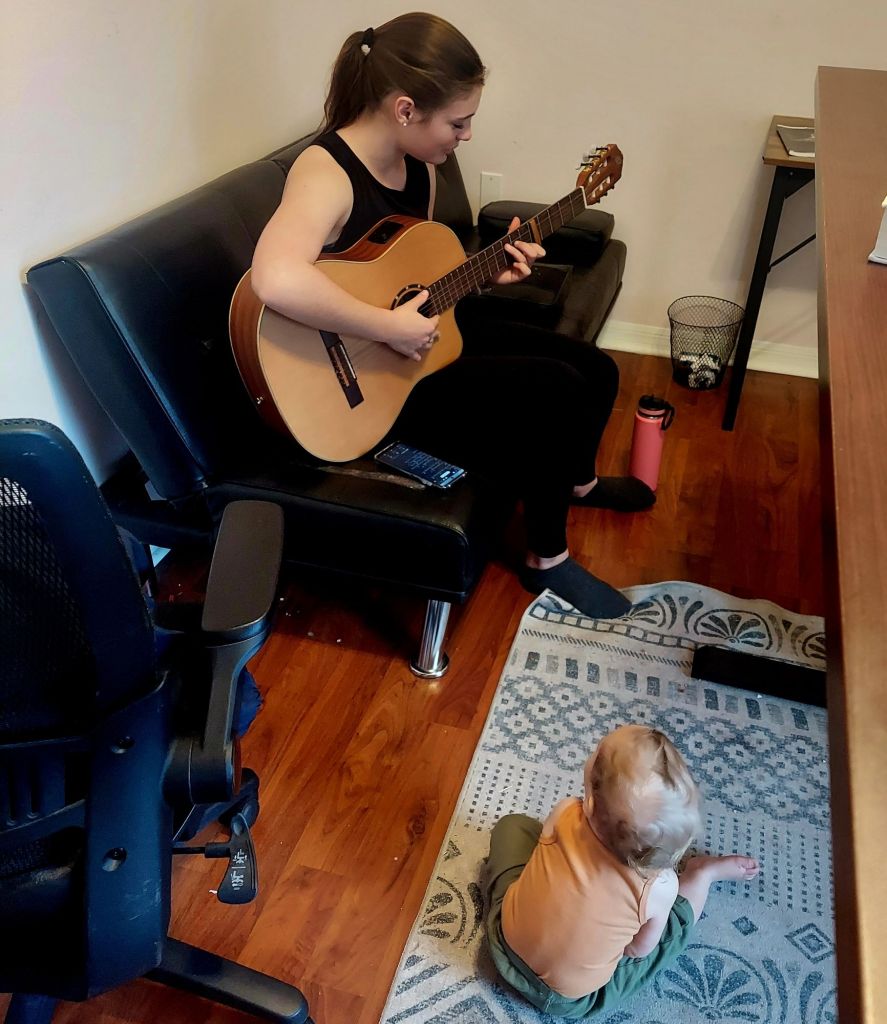
Here is the truth: our daughter may have been born to dance, but she was also born to do so much more than that. She was born to serve others, to go on adventures, to make music. She was born to grow, to strive, to seek, to suffer, to love, and to make of her life something beautiful.
To the extent that dance has been a part of that journey, it has been great. But that’s not the end.
Our children have a depth and a breadth that far outpaces our easy understanding of them or even their own self-understanding. While the slogan, “You can be whatever you want to be” is certainly misleading, within the perimeter of their limits, children do have an infinite set of possibilities. The mystery and dignity of the person and the horizon of possibility within each of us vastly outstretches the easy understanding we have of ourselves or our children.
As parents, we need to recognize that the question of identity is a lifelong journey. Our children need to be encouraged to have grace and magnanimity in the face of every challenge, seeing every day as a classroom and an opportunity to grow and discover. And we parents must not take for granted the living lessons we discover as each step of the journey unfolds: the beautiful heart and deep personality at the core of the children entrusted to us.

Leave a comment