Last summer, the kids and I had an experience we still discuss from time to time. While on our road trip to Boston for Highland Dance national championships, we realized the kids needed a few clothing items. I usually buy most of our clothes secondhand, but since we had so little time to shop around and weren’t familiar with the consignment and thrift stores in the area, we decided to head to a place our younger kids had never even been before: the mall.
After wandering around for several hours and looking in many stores, we hadn’t found anything. All the clothes were either ugly or outrageously expensive. I was starting to lose hope, but decided to go check out one more store at the other end of the mall.
Down the corridors we walked, past nail salons, through the food court, and finally into the entrance of what turned out to be a liquidation warehouse. The place was dimly lit and full of shoppers picking through bin after bin of brand new clothing, all marked down to approximately 10-20 percent of retail value. In fact, I saw an entire box full of girls’ dresses I’d been eyeing at our local Target for the last few months. I’d even put the dress in my cart a few times at my local store, only to remove it at the last minute because $30 seemed like a lot for a dress my daughter would probably outgrow within a few weeks. And here it was, in a grungy plastic bin with dozens of other identical dresses in various sizes, selling for $3.97.
You might think such steep markdowns would result in a full shopping cart, but this place had the opposite effect. All I could think about was the fact that a minute percentage of these clothes would actually be purchased. What would happen to the rest of it? We had caught a glimpse of the underbelly of the clothing industry, and the feeling of excess was overwhelming and a little sickening. The lines were also oppressively long.
So we left the store empty-handed and headed for the local Goodwill. I vowed to never again fall for the myth of “retail value.”
3 Ways to Stop Relying on Retail
In 2024 we did two of the things they say never to do if you want to reduce spending: We moved, and we had a baby. For those reasons we were already trying to cut household costs, even before this experience at the liquidation warehouse.
But in the meantime, we’ve realized that consuming less makes us a lot happier. When you let go of the need to buy new and have the next best thing, there’s a contentment that settles in. We’ve started to feel a little bit of that in 2024, thanks in part to these three practices we started to make a habit:
- Start With Secondhand. If we have a need, we always look for it at a secondhand store before heading to the retail shops. Sometimes we have to go to a couple thrift stores and consignment shops, but with a little patience, we usually find the item used.
- Join Your Local Buy Nothing Group: In addition to shopping secondhand, we discovered another great resource for lessening waste: the Buy Nothing Project. The project utilizes social media to decrease waste and create a local network of gifting. We’ve given and received so many items via our local group, including bikes, baby items, plants, an espresso maker, a coffee table, and a rug (to name a few!)
- Sort Through Your Belongings Every Month: As Marie KonMari says, “Tidying is about what you want to keep in your life, not what you want to eliminate.” As a family, we’ve gotten into the habit of regularly sorting through our possessions and asking why we want to keep them in our house. If there’s not a good reason, or if it’s immediately clear that someone else would appreciate it more than we do (which is often the case!), we give it away.
These three practices have saved us a lot of money in the last year, but that’s just a pleasant side effect of the real point: To not lose sight of the fact that there’s enough to go around, and to be happy with that.
The Challenge of Forgetfulness
It all sounds so simple, but it’s been surprisingly difficult to live this way. I think that’s partially because from a young age, we’re taught never to settle for “enough.” To always seek after the next best thing, the bigger house, the fancier car, the upgrade. To always ask for more, even when we feel content, because more simply seems better.
Slowly we discover “more” is unending and never satisfies.
But how quickly we forget. Not even two weeks after the liquidation store, I found myself in my local Target yet again, putting cute clothing items that I didn’t need in my cart.
Forgetfulness is an easy trap to fall into, because so many of the unjust practices that fuel our consumer culture are unseen. Child labor, human trafficking, the environmental impact of fast fashion – we don’t see any of it. And so we all forget the level of excess we generate as a society, all the time.
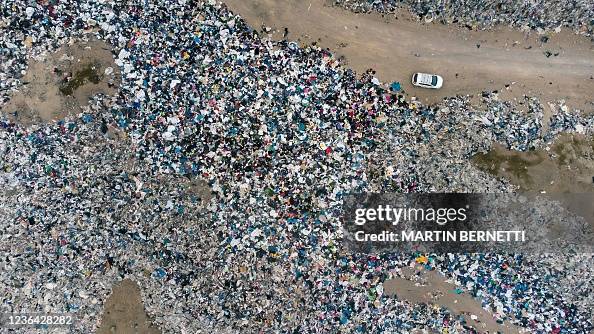
Or perhaps we’re ignorant of the extremity of the problem. For example, I only recently learned about the mountain of discarded clothes in Chile that regularly poisons the inhabitants of the nearby village when the clothing is burned and all the fumes are released into the air. The clothing patch is so big it can be seen from space.
And while I knew there was a giant plastic patch floating in the ocean somewhere, I only learned last year that there are an additional four patches that have been identified. Scientists have known about these patches for decades, and yet the patches are still growing and impacting the environment in ways we don’t understand.
What’s the Plan?
“So what was the plan?” my 10-year-old son asked when we read about the garbage patches (this was part of a family unit study we did on oceans about a year ago).
I asked what he meant by that.
“Well, was this the plan with all this stuff? To just let it all sit in the ocean? Because that doesn’t seem like a very good plan.”
I didn’t know how to answer that. The more you learn, the more it seems all this stuff is actually made to be thrown away.
But that doesn’t mean we can’t have a better plan. So we decided our plan is to try, to our utmost, not to add to the garbage patch or the mountain of clothes. To be content wearing clothes and using items that have been owned before, and to pass them on to others when we’re finished with them. To use materials that the Earth will receive readily when we don’t need them anymore. And most of all, to be content when we have enough and not seek more than that.

Leave a comment