[WARNING: This is a birth story, so don’t read it if you’re squeamish about birth.].
Earlier this week, we celebrated our son Jude’s 11th birthday. As I was telling him about the day he was born, I realized I’ve never written his birth story. When I used to work as a doula, I always encouraged my clients to write out their birth stories as soon as possible after delivery, while it was still fresh in their mind. I didn’t follow my own advice with Jude, but I suppose it’s better late than never! So here is the story of the day Jude was born.
A Bit of Background
Jude is our third child, and his birth was particularly special because it was our first unmedicated birth experience. His two older sisters were both comfortable in a breech position, which is when baby is head up instead of head down. At the time, the only option I was aware of for a breech delivery was a c-section. So despite our hopes to have a natural birth, both our girls were delivered via cesarean – one in 2008 and another in 2011.
To be clear, all our kids’ births have been special. And even though having two c-sections was not in my plans, every birth has a lesson to teach. My c-sections taught me not to cling too tightly to any sort of ideology when it comes to birth. I had to let go of all my preconceived notions and come to a place of total humility and acceptance. In the end, my c-sections were beautiful and incredible experiences that I needed to have.
But they were also difficult, physically and emotionally. So when we found out we were expecting again in 2013, we set our hopes on a natural delivery. It’s hard to find a provider who will support a vaginal birth after two c-sections (also known as a VBA2C), but it’s even harder to find one who will attempt a VBA3C, so we saw this as our last chance.
When Jude decided to stay head down through the whole pregnancy, I started to get excited. As the day got closer, I noticed a bit of fear creeping in. I was afraid to anticipate things too much, knowing how unpredictable birth can be, but also clung to the hope that we would finally get to experience the natural birth we’d always felt drawn to.
Before we knew it, I was 35 weeks pregnant. The pregnancy had been my easiest yet, with no complications. In our experience, babies have a personality even in the womb, and Jude was no exception. I was very into fitness during the whole pregnancy, and was weight training all the way up to the week he was born, as evidenced by these prenatal strength training workouts I wrote for a website I was working with at the time. To this day, Jude remains a workout fanatic. I think that goes back to his good ol’ days in utero!

At 35 weeks, 4 days, I had a visit to my OBGYN. He did a pretty aggressive cervical exam and told me I was already 2cm dilated and 80% effaced. He said I might experience some spotting later in the day but not to be concerned. Well, he was right. Not only did I have spotting the rest of that day (it was a Friday), but it went on into Saturday afternoon and was soon accompanied by regular contractions. I was in early labor!
I was so excited to finally be having this experience that I was thrilled with every discomfort. So when things completely stalled out late Saturday evening, I was crushed. I went to bed Saturday night thinking that all the so-called labor pains I had experienced over the last 24 hours were just false labor.
But then, on Sunday morning just as we were heading to church, they started up again. This time, they kept up and started to get closer together and more powerful. Around 6pm, we were at Chipotle ordering our dinner and I had a contraction that was so intense I had to stop telling the guy at the counter what I wanted on my burrito so I could take some deep (and loud) breaths. This seemed like the real deal, so we called our friends who we had asked to watch our girls when the time came, and let our OBGYN know we were going to come in.
At the Hospital
Once the hospital bags were ready and the girls were settled, we headed in. We arrived at the hospital right around 9pm. I was 4cm and completely effaced, and contractions were pretty consistent. We were having a baby!
But then, right around 10pm, the same thing that had happened the night before happened again: things slowed down. The contractions that had been five minutes apart at most were now happening only a few times per hour, and they were pretty wimpy.
We walked around the room a bit and I tried some maneuvers on the birth ball, but nothing seemed to help. Finally the nurse suggested that I try to get some sleep in case things picked up again. Around 11pm, I decided to just surrender and sleep. Peter and I were both exhausted, and I was starting to worry that if labor did pick up I wouldn’t have the energy to get through it. I tried to remind myself to be grateful to have made it this far and not feel discouraged.
I must have been pretty tired, because I slept deeply. The contractions continued through the night and were strong enough to wake me up, but I was sort of in a twilight zone and was able to easily doze off again. It was wonderful, until I looked at the clock and realized it was 5am.
Right around then, the nurse came in to check on my progress. I had just gotten up to use the bathroom and the contractions had already intensified, so I was pretty excited. I thought I must be at least 7 or 8 centimeters since it had been so long.
Nope. On the contrary, nothing had changed. Six hours later and I was only 4cm, and to make matters worse, the nurse said I now had a cervical lip that might be the reason things weren’t progressing.
She called the OB to determine next steps, and he told her I needed to be put on Pitocin to get things going again. He said he would be in around 6 to check on my progress. This was around 5:30am.
Things Get Interesting
Even though I was annoyed by the stalled labor, I felt grateful that both the baby and I had managed to get through contractions so far without needing pain relief. But I was definitely at the edge of my pain tolerance, and I worried that taking Pitocin would intensify the contractions so much that I wouldn’t be able to manage them. I also worried that Pitocin might make it more difficult for the baby, who had been tolerating contractions perfectly up to this point. Both of these are common concerns with Pitocin. From the Journal of Perinatal Education:
Pitocin disrupts the normal physiology of labor. Because Pitocin does not pass the blood–brain barrier, there is no endorphin release. The stronger, harder contractions are difficult for the mother to manage and put additional stress on the uterine muscle. To manage the very strong contractions, epidural analgesia is often given as soon as the Pitocin is started. Epidural analgesia interferes in its own ways with the physiology of labor and adds additional risks for mother and baby.
And so we politely (but firmly) told the nurse we did not want to start Pitocin. I said I wanted to get up and move first and also try getting in the shower to see if the water provided any relief. She reluctantly agreed and said she would be back to check my progress in 20 minutes to see if we needed to start Pitocin.
This was a pretty crucial moment in our birth story. I still remember feeling kind of bad for the nurse and hoping she didn’t get in trouble with the doctor. But I just had a gut feeling that if I moved around a little bit, things would progress. That feeling was right on.
The Shower
I walked around the room a bit while Peter got the shower ready, and the contractions already started to pick up again. By the time the water had warmed up, I was already back to having contractions every 3 minutes. I got into the shower and the relief was absolutely amazing.
I just stood there enjoying the hot water and breathed through a few contractions. Then I started to feel the contractions in my back, so I asked Peter if he could detach the shower head and spray my lower back. As I leaned forward and the water hit my lower back I felt a huge contraction – the biggest one yet! – and then I felt a new sensation that was kind of alarming. Basically it felt like the baby had just dropped rapidly into my pelvis and was about to be born. That was in fact what was happening, because my water had broken.
I’ll admit that in that moment I thought this was the end. Like, the end of my life. The pain was unlike anything I had ever felt before, and there was a lot of blood. I screamed for Peter to call the nurse, and she came running in, totally shocked to find that our plan had actually worked! She reassured us that everything was okay, the amount of blood was normal, and this probably meant we would meet our baby soon.
Peter and the nurse walked me back to my bed, and right around then the OB came in. “Guess that Pitocin worked, eh?” he said to the nurse. She told him we had declined and he was a little puzzled. Peter proudly told him I had done a “Jungle Mama Dance” in the shower to speed things along. (To this day, Jude has some swingin’ dance moves, so maybe that’s why it worked.)
I don’t really remember much of the next thirty minutes. When the doctor arrived at 6am, I was almost 10 cm (remember, I was only 4cm an hour before. This is why I don’t put much stock in cervical checks, but that’s another blog post). The contractions were basically nonstop at this point, and 30 minutes later we held our baby in our arms.
The gender was a surprise. Our first little boy!

Cloud Nine
After he was born, I remember feeling so grateful for the mental clarity and physical strength I felt. I know a lot of women prefer c-sections, but for me the recovery was pretty difficult. My second c-section incision came open right after delivery and refused to close, so I was on bedrest for six weeks after delivery (with a 2-year-old running around). I was amazed at how energetic I felt in comparison after my VBA2C. At one point, a few hours after Jude was born, both he and Peter dozed off, and I remember seriously considering going for a walk down the hall! (Don’t worry, I didn’t.)
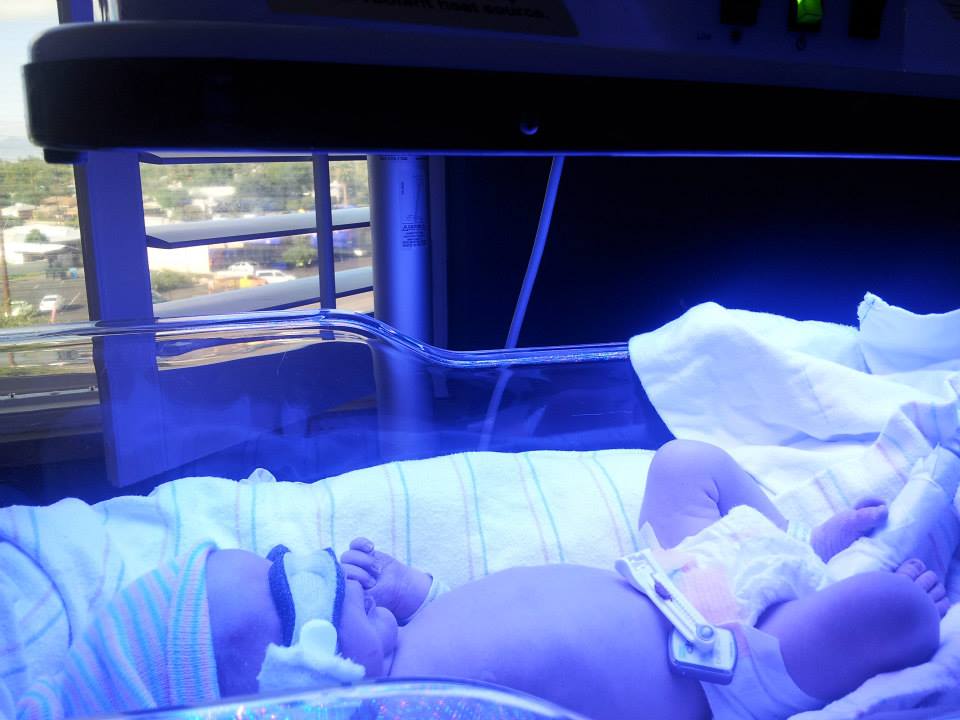
Jude was technically a premie (born at 35 weeks, 6 days) and was only 4lb, 15oz at birth, but his lungs were strong and he nursed like a champ. I was grateful that he didn’t have to leave my side and go to the NICU (although he did have jaundice and had to go under the lights, which is where his nickname “Jude the Dude” originated).
Other than that, everything went smoothly. Jude was an easygoing baby, and his sisters were absolutely in love with him. Our little toddler, Sunniva, learned all the lyrics to “Hey Jude” and sang it several times per day in her sweet little voice.
And I went on to have four more VBA2Cs, including three at home (two of which were breech deliveries).
Tips for Having a VBAC
If you’re reading this story and are also hoping to have a VBAC, I can give you these five pieces of advice that we learned during Jude’s birth:
- Find a supportive provider. Check hospital VBAC rates, interview multiple providers, and ask for referrals from moms who have had a VBAC already. If you’re unfamiliar with the VBAC-friendly hospitals and doctors in your area, look for a local chapter of ICAN (International Cesarean Awareness Network) to connect with VBAC-friendly practitioners.
- Hold off on interventions as long as possible. Remember, you are ultimately the one in charge of the decisions you make during labor. If you don’t want to intervene in the process with an epidural or Pitocin, you don’t have to. I know this seems like common sense, but it can be difficult to remember in the moment when you feel pressure from doctors and nurses. Unless there is a medical reason to intervene, try to let your body do its thing.
- Maintain freedom of movement. Changing position during labor is key not only to managing pain but also helping baby engage. It never ceases to amaze me how just a slight shift in position can suddenly turn a stalled labor into a baby being born. This was definitely the case with Jude and has also happened with my other births since then. Keep your movement options open so you can shift position to get comfortable and help baby engage.
- Have a support team. Make sure every member of your birth team is positive and on board with your decision to have a VBAC. You’ll probably have moments when you doubt yourself, and having people who support your wishes is crucial in those moments.
- Take it one contraction at a time. This is good advice for childbirth in general, but especially if you’re trying for a VBAC. It’s so easy to get swept up in “what ifs” and hypotheticals, or if your previous c-sections were difficult, to get stuck in past experiences. Just focus on getting through one contraction at a time, and then say a prayer of gratitude after each one is over. You are one step closer with each one!
Thanks for reading! Have you had a VBAC? What was your experience like, and what advice would you offer?

Leave a comment