About six months ago we sat down to evaluate our household spending. We found we spent about $1500 per month on food, or $325 per week. That’s not an astronomical amount considering our family size (8 people eating). The USDA says a family of four spends an average of $1,578 for a “liberal budget” and $969 for a “thrifty” food plan.
But after a year of high family costs due to a big move, some car expenses, and having a baby, we wanted to do even better so we could jumpstart our savings. We decided to make an outrageous goal of only spending $1,000 per month on groceries.
Fast forward to August 2024, and we finally hit that number!
We wanted to share some tricks we’ve discovered along the way to keep our grocery bill to a minimum. While a few of these things seemed like they would take a long time and be impossible to fit into a busy schedule, once we made them a habit, they weren’t that time-intensive.
1. Look for common threads. Find meals you all love and that share common ingredients, and eat them several days per week. Years ago I bought a great cookbook that’s based on this concept, called Cook Once, Eat All Week. (In fact, several of the staple meals in our rotation are from this cookbook.) Basically, the author’s point is that if you can plan your week with meals that share common ingredients, you’ll spend less money and also make your time in the kitchen more efficient. This has been a great overarching principle in making our meals delicious, healthy, and affordable.
2. Eat less meat. I was scared to commit to this for a long time because I love my bacon in the morning and a nice steak or burger every night now and then. It’s taken some time, and we’re not meat-free yet, but we have drastically decreased the amount of meat we buy each week. Currently we purchase less than ten pounds of meat and seafood per week, and the rest is fresh or frozen produce, beans, rice, and legumes.
3. Stop buying bread. This was a huge expense for us before. Once again, we haven’t completely ditched store-bought bread, but we took our intake down from four or five loaves per week to no more than two. Our girls love baking bread, so they make a loaf or two each week to enjoy right out of the oven as an afternoon snack, and we have French toast made with store-bought bread once a week on Fridays as a treat. When I do buy bread, I only buy it on sale and stick it in the freezer for future use.

4. Snack seasonally. Most of our snacking involves fruits and veggies, and I’ve found that living in Florida makes it easy to get delicious fruit for great prices, since there’s always something in season. We picked and ate a ton of berries in the first half of the year, and have been loving watermelon this summer. If you’re not sure what’s in season where you live, this website has helpful charts for all the states.
5. Ditch the alcohol. I love (good) beer. It’s probably my favorite beverage. But man, does it deplete the budget line (and now that I’m getting older, my energy levels!). We haven’t purchased alcohol this month with the exception of a few celebratory date nights, and the savings has been huge. For example, let’s say you purchase a 6-pack to enjoy over the weekend, which costs $14. That’s almost $60 per month that you could save! It also makes the occasional beer or glass of wine all the more enjoyable.
6. Buy dried beans and legumes. We eat a ton of beans, lentils, and chickpeas, and I’ve come to prefer buying them dry instead of canned. For example, I buy a 2-pound bag of black beans once a week at Aldi that costs about $3. That bag makes about 14 cups of black beans, which is enough to last us the whole week. To get that much from cans I’d have to buy 10 cans. If each can cost $1 (best case scenario), that’s three times the cost.
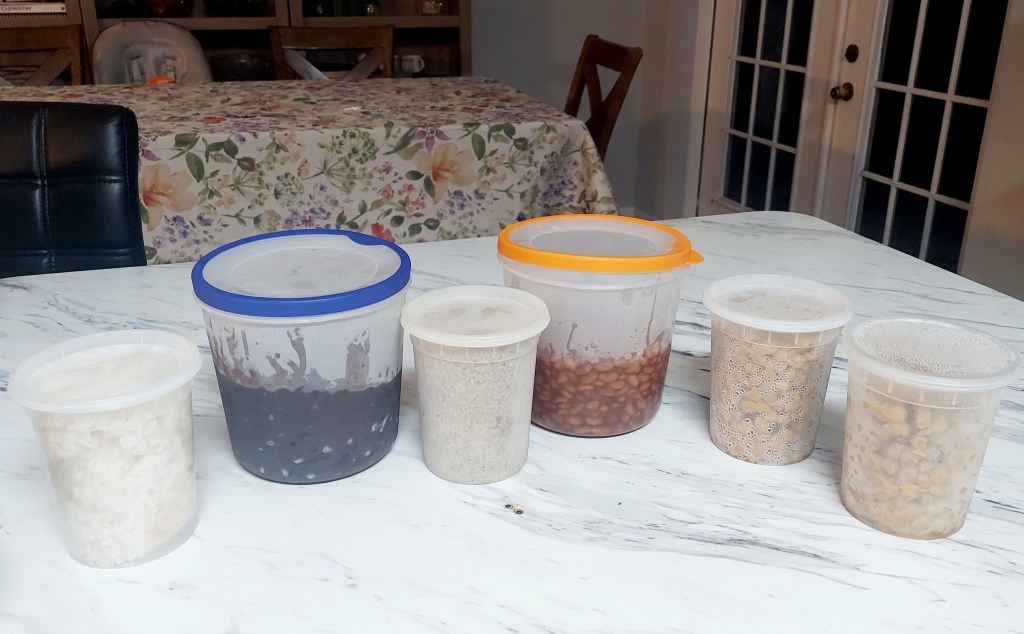
When you do this with a lot of different kinds of beans and legumes (chickpeas, pinto beans, and lentils are others we eat on a weekly basis), the savings add up quickly! The white rice, black beans, pinto beans, quinoa, and chickpeas in the photo below cost about $5 to prepare and lasted us over a week. To buy this much canned or pre-made would have cost at least $15. That’s another $60 per month saved by preparing it myself, and it took probably fifteen minutes of work total thanks to my Instant Pot.
7. Shred your own cheese. Our kids love cheese, and the younger ones eat a lot of bean and cheese quesadillas and egg/cheese/bean tacos. I haven’t done a cost analysis of this at Costco (partially because we’re trying to eat less cheese so I don’t want to buy huge quantities), but I’ve found that buying the block cheese and shredding it myself generally costs about half the price.
For example, at Aldi a 2-cup bag of shredded cheese costs a little more than $3. An 8-ounce block costs about $1.95 and comes out to exactly 2 cups when I shred it. We were buying about four bags per week (about $12.50) and now only need to buy four blocks (less than $8). It’s a small savings, but it adds up to almost $20 in the monthly picture!
8. Oats, rice, potatoes. We eat these three foods every day. Whoever is the first to wake up starts some oats in the rice cooker first thing in the morning. For lunches and dinners, we often have rice with beans, lentils, or a veggie stir fry. Or we have some dish including potatoes, such as a sheet pan veggie dinner, shepherd’s pie, or a meat or seafood dish with mashed potatoes. All of us are pretty active, and we find these three foods to be healthy sources of carbs to fuel our activities.
9. Learn how to make condiments. We make all our own salad dressings, sauces for meals, and recently started making homemade hummus, and we’ve saved so much money on condiments.
For example, I can purchase a one-pound bag of chickpeas for less than $2, cook them and blend with a bit of olive oil, tahini, lemon juice, and salt, and I’ll have enough hummus to last us a week. Before, we could go through a giant tub of hummus that cost $8 per week. Once again, it’s only $6 per week of savings, but it’s almost $25 per month.
10. Drink more water. One of my midwives told me that thirst often disguises itself as hunger, and I’ve definitely found this to be true. If the kids ask for a snack and they ate recently, I always tell them to drink a glass of water and come back to me in 20 minutes. Most of the time I don’t hear from them again for at least another hour.
11. Make a list of fancy foods you like…then learn how to make them!. Chances are, they’re pretty inexpensive. We discovered this recently with one of our favorite foods, sushi. We spent about $30 up front to buy the staple ingredients and sushi tools, and now we can make fresh sushi once a week to feed our whole family. And best of all, everyone feels like it’s an extravagant treat!

12. Shop strategically: Sometimes it’s cheaper to purchase all your groceries at the same store, especially if there’s a lot of drive time to factor in. We usually shop at three stores per week (Aldi, Costco, and Walmart), which is pretty convenient and not too time-draining, since we have an Aldi and Walmart right across from the street from each other, as well as another Aldi and Costco in the same shopping center. We purchase most items at Aldi, but some products are cheaper at Costco and Walmart.
For example, we go through four bags of kale per week, which cost over $4 each at Aldi but are only $3 at Walmart. We’ve also found that Costco is the cheapest place to buy dried fruit and rolled oats. As another example, a 2.6lb tub of rolled oats costs about $4.50, but you can get a 10-pound bag at Costco for $8. Our kids love oatmeal so we go through about 5 pounds per week. We were spending about $36 per month getting oats at Aldi before, but now that we purchase at Costco we only need two bags, which costs $16. Knowing where to buy just those two items (kale and oats) has saved us $40 per month!
In Conclusion
If you add up just the bolded amounts in the tips above, that comes out to more than $200 of savings per month. That doesn’t even factor in the amount of money saved by eating less meat, meal planning around staple and in-season foods, and buying less bread. Just cutting down our meat consumption from 20 pounds to 10 pounds per week accounted for most of the remaining $300 per month.
There are many other happy side effects we’ve experienced since changing our shopping and eating habits, but here are just a few:
- We’ve gained so many new skills and shared time together.
- Funny enough, we’re able to eat organic foods more often, since we’re eating more produce and less meat, which has a higher cost per pound.
- Our kids are more aware of what it actually costs to feed a family and more confident in their cooking abilities.
- On the rare occasion that we eat out or have a splurge meal, we all appreciate it so much more.
If you’re looking at this list and thinking, “That’s great, but it looks like a lot of work!”, I’m not going to lie. It is more work.
But if sticking to a frugal budget is a priority for your family, the effort will pay off in the long run, in more ways than one. The time we’ve spent preparing food together as a family has become something we look forward to. More meaningful work, more skills learned, less waste, and less money spent – I’ll take it.
Stay tuned for a sample weekly meal plan based on these tips, and please share your secrets for healthy eating on a budget in the comments below!

Leave a comment